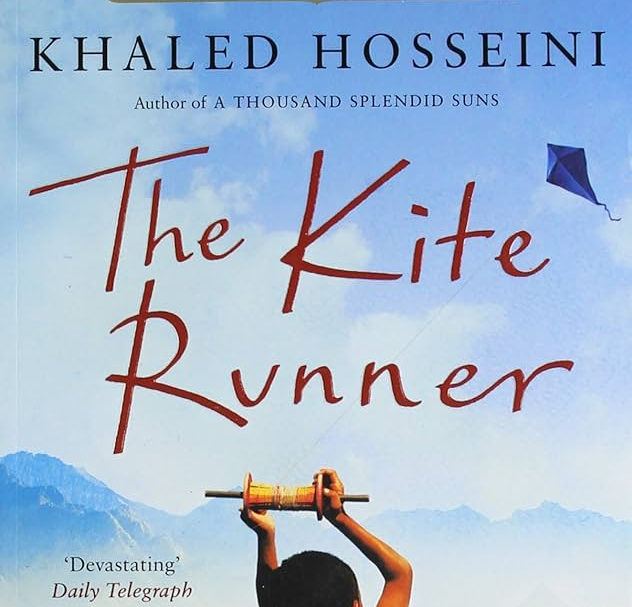
1970s Afghanistan: Twelve-year-old Amir is desperate to win the local kite-fighting tournament and his loyal friend Hassan promises to help him. But neither of the boys can foresee what would happen to Hassan that afternoon, an event that is to shatter their lives. After the Russians invade and the family is forced to flee to America, Amir realises that one day he must return to an Afghanistan under Taliban rule to find the one thing that his new world cannot grant him: redemption (Goodreads).
The Kite Runner follows the story of Amir through his tumultuous but happy youth in Kabul with best friend Hassan to his escape to and life in America.
Warning, this book is best experienced without knowing what happens, so this is your early warning that this review will contain spoilers and some mild analysis!
As an International Relations student, I have studied many international conflicts and one of my latest assignments was on Afghanistan’s transition of power from 2021-2024. It was incredibly interesting, and I wanted to learn more about the country and realised that I had this book sitting on my shelf from a while ago. So, I thought it was time to read it.
Now, I know that this book is not new, and while I may be the last person to read this, I now understand why this is story is in the running (no pun intended) to become a new classic. I flew through this book, and found myself moved to tears at so many moments. Now personally, I think that one of the greatest achievements of any type of art is to make one think and especially to feel something.
And boy does this one make you feel…
The boys’ youth in Afghanistan is not what I would call idyllic, but it was sweet and its clear that the boys had fun. I enjoyed reading about their time in pre-Taliban Afghanistan. Learning about their daily life was interesting, and I loved hearing about the lively community of Kabul through Amir’s eyes. Like any story about childhood innocence, it starts out comforting and gentle, even during the military coup where the boys are afraid, Ali is right there to comfort them.
Yet, like every story about the loss of childhood innocence, it must all shatter eventually. What happens to Hassan is horrifying and devastating because as shocking as it is, sexual violence is not nearly as uncommon as one might hope. In Australia alone, 11% of women and 3.6% of men have reported experiencing sexual abuse prior to the age of fifteen. Of course, different countries with different cultures and practises will all have unique figures and instances, but the shame and trauma associated with sexual violence means that few people choose to speak up and on average, it may take upwards of twenty years to even disclose the event with another person.
Conflict zones are also hotspots for sexual violence, as militants take advantage of the displaced and desperate people, with women and children as primary targets. In some instances, militants may trade food, water, aid, or other privileges for sexual favours from these desperate people, while other times rape and assault are rife simply because victims are powerless to stop them. This violence may also be used as a terror tactic, to subdue and instil fear in groups so as to keep them from acting out.
However, we’ll return to this discussion later on in the story. For after Amir witnesses Hassan’s rape, he cannot bear the guilt and shame he feels for not trying to stop it. As the boys grow apart afterwards, Amir plots to get rid of Hassan, and does so by framing him as a thief. Now, Baba, whom Amir adores and desperately wants to please, establishes early on that theft is the one unforgivable sin.
Hiding his watch in Hassan’s small servant hut, Amir tells his father that it is gone and they confront Ali and Hassan. During this ordeal, Hassan realises Amir’s plan and tells his father Ali everything that happened to him, and they decide to leave. In a heartbreaking turn of events, Baba tells them that he forgives Hassan for the theft, forgives them both and wants to make it right, but they have made their decision. It is here that the stony and strong Baba…bursts into tears. This moment hit home just how much he loved Ali and Hassan, and showed the depth of pain Amir continued to cause with his actions.
It was also this moment in which I realised how masterful Hosseini was in giving information at key points only to bring it back later in more heart-wrenching ways. Just as we learned how much Baba hated theft early on, this moment also revealed the depth of his love for Ali and Hassan, which is revealed to be the result of his guilt over fathering Hassan without Ali’s knowledge. After noticing this pattern, I began to find the intricacy of the story so much more gripping, and made note of everything mentioned – from Baba’s fight with the bear to the razor blades later on. Hosseini delivered on every narrative thread introduced, and as a writer myself, I found this to be a wonderful example of powerful and intelligent writing.
Personally, these hints are both intriguing to read about and act as clever foreshadowing, to make the story more puzzle-like. I found myself guessing what might happen next, though I was still devastated to hear the results.
To be truly honest, I think I could analyse this book for hours, but for the sake of brevity I will aim to keep my discussion concise.
The escape to America was harrowing, and Amir’s carsickness added additional unease. Baba’s refusal to allow the Roussi soldier to rape the young mother was made more agonising by the parallel it drew to Amir’s cowardly retreat during Hassan’s own assault. After he refused to back down and they were released, it drove home how a second voice could make all the difference.
Amir’s life in America was marked as different to his time in Afghanistan by the fleeting way he described it. There were mentions of his surrounds and life in the city, but nothing like the joyful explanations he gave of Kabul in his youth. His loss of innocence destroyed his ability to see beauty in the life around him, though he retains this affection for the other Afghan people he meets in America.
Soraya’s history as a woman ‘tainted’ by her previous relationship with a man mirrors Hassan’s and later Sohrab’s story in several ways. Perhaps Amir sees marrying her and in a sense redeeming her as a way to redeem both Hassan and himself. Later when they cannot have children, I wonder if both characters saw it as a form of punishment for their own transgressions.
The reveal that Hassan was Baba’s son did not exactly shock me, for I assumed something of the sort, but it was still devastating to learn of his betrayal against Ali. The story does show how cycles repeat themselves in families, from Baba’s failure of Ali to Amir’s failure of Hassan, and of course Assef’s treatment of both Hassan and Sohrab. I do wish we had been able to meet with Hassan one last time, but his death made sense in the context of the story, and made his imploring letter all the more painful.
Baba’s legendary fight with the bear that Amir recalled with such reverence was another important point which we returned to often. The bear is a symbol commonly associated with Russia, and represents Baba’s continuous struggle against the Roussi forces which tormented them throughout the novel. However, in America, as Amir notes, Baba’s bear became the cigarettes and cancer which killed him.
Lastly, Hassan’s choice to name his son Sohrab shows his own thoughts about the poem he and Amir loved in their youths. In naming his son this way, I wonder if Hassan himself identified with Sohrab’s struggle and death at the hands of his father. Did he associate this relationship with Ali? Baba? Amir? Was it the sheer injustice of Sohrab’s death that touched him? Or did he see himself in Rustam? Either way, instead of Hassan killing his own son, Hassan is the one killed while his son is taken and hurt by the same man who hurt him all those years ago.
Themes of family, shame, and how one’s choices affect your life are central to forming this unforgettable story. Reading has always been an incredible way for me to learn more about others and the world around me, and I believe this story will stay with me forever. Amir’s struggle to grow up and reconcile his past and present is a universal struggle, and I was glad to see him grow out of the meanness he learned so early on. While the ending of this book was not necessarily what I would call fulfilling, but I was glad to see Sohrab taken care of and to hear Amir now promise him, ‘For you, a thousand times over.’

 Devin's World
Leave a comment