
Helping to maintain a clean environment is incredibly important for me, and something I strive towards daily.
As an Aussie, we grow up with a healthy respect for nature, mostly because a lot of stuff here genuinely can hurt or kill you. Animals are just one small part of this, because the environment itself is just as dangerous. We don’t have seas like the gentle Mediterranean that I swam in at Cinque Terre, but the Pacific, Indian, and Southern oceans. I grew up learning how to deal with rip-tides and dangerous currents, on top of battling the jellyfish and sharks.
The sun here is no joke either, and the birds can be either friendly, hostile, or friendly then hostile at the drop of a hat. The grasses can contain all sorts of itchy or spiky plants (hello bindis) or bugs and creepy-crawlies that’ll ruin your day. All this makes it sound like Australia is a battleground but I promise it’s not that bad, especially if you grow up learning how to deal with all this.
As I said, we grow up with a healthy respect for nature, and learn to appreciate our beautiful country safely—or as safely as you can.
My sister studies environmental management, and thus speaks a lot about the importance of preservation, protection, and promotion of the environment. I’ve learned a lot from her, and she always challenges us to be better about our practises. One such practise is our plastic waste.
Recently I saw a couple videos of women who collect their plastic waste and store it in a bottle. They do this to reduce their waste volume, but also to contain the soft plastics.
Plastic, as we know, does not biodegrade. Instead, it breaks down into tiny particles known as microplastics. These tiny plastic pieces less than five millimeters in length are about the same size, or smaller than a sesame seed.
We know that microplastics are flooding the earth, waterways, and the bodies of living organisms at an extreme rate. This article by Reuters helps to visualise how much plastic we ingest, with estimates that “People could be ingesting the equivalent of a credit card of plastic a week”.
Disgusting. Invasive. Unnatural. Unjust. Wrong. These are just some of the words that come to mind as I think about this.
Even if these estimates are wrong or inaccurate (I have seen some studies suggesting otherwise), I argue that ANY MICROPLASTIC CONSUMPTION is wrong. Doesn’t matter how much. We should not be putting this crap in our bodies, because it shouldn’t be there in the first place! Somehow, there will be someone who finds fault with that or wants to point out that ‘ackshually‘ I’m imagining some utopia that we cannot possibly reach (as if we didn’t have thousands if not millions of years without plastic. Sigh).

Anyway, I am not going to buy into the stupid ‘giveupism’ that is rampant at the moment. Our actions do have meaning, and every little bit helps when it comes to putting a stop to this crap.
So, I’ve started collecting our soft plastic and stuffing it into a plastic bottle like these other women. If I can stop a little bit of plastic waste getting into the world, the waterways, animals, myself and other people, I’m going to do it. It’s like we’ve all forgotten that we actually do have a duty to care for one another and the world we live in. (Genesis 1:28 anyone?)
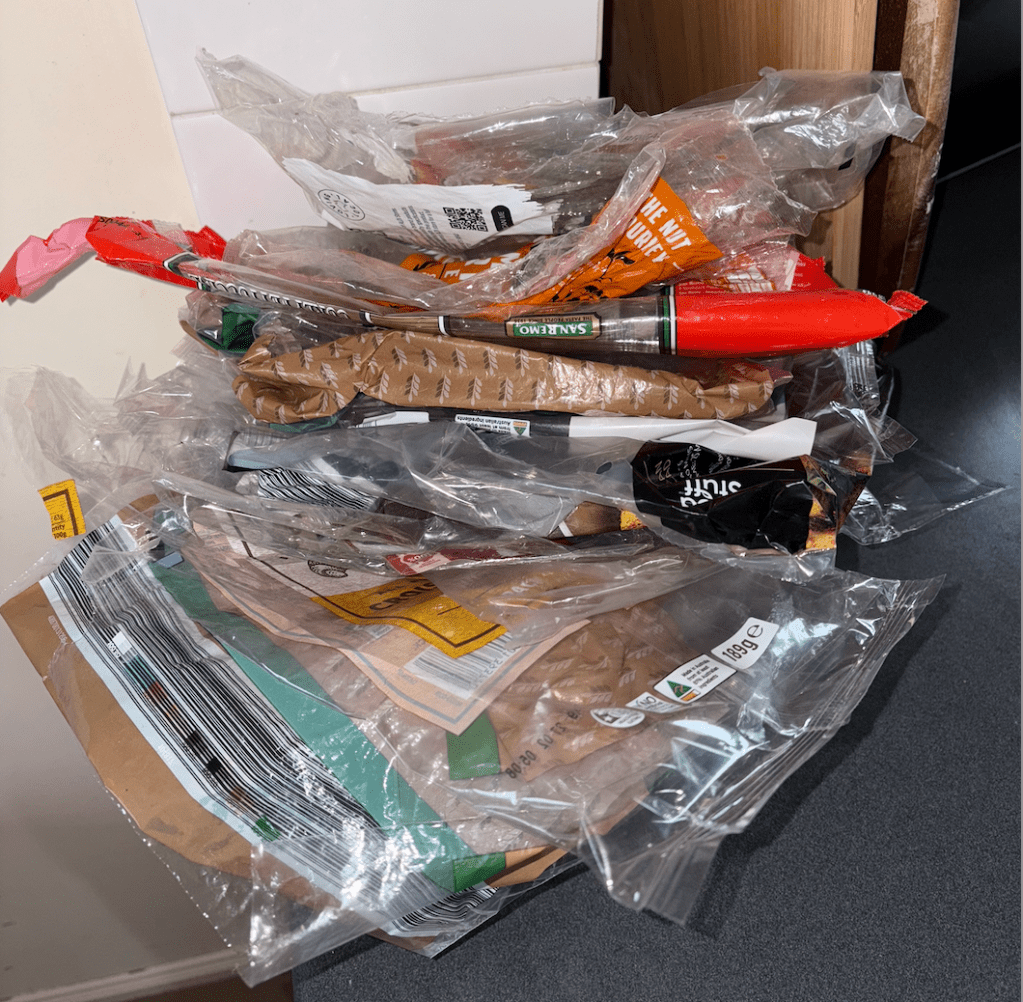
I was honestly surprised to see how much plastic we actually use. Below is a picture of the collection from the last week (it’s been busy mate, I know I’m behind). The amount of it stacks up fast, and I’ve started to think about how we can change what we buy to consume less. It doesn’t help that plastic is so cheap and convenient, but I am optimistic that with changing values, we could change the system entirely.
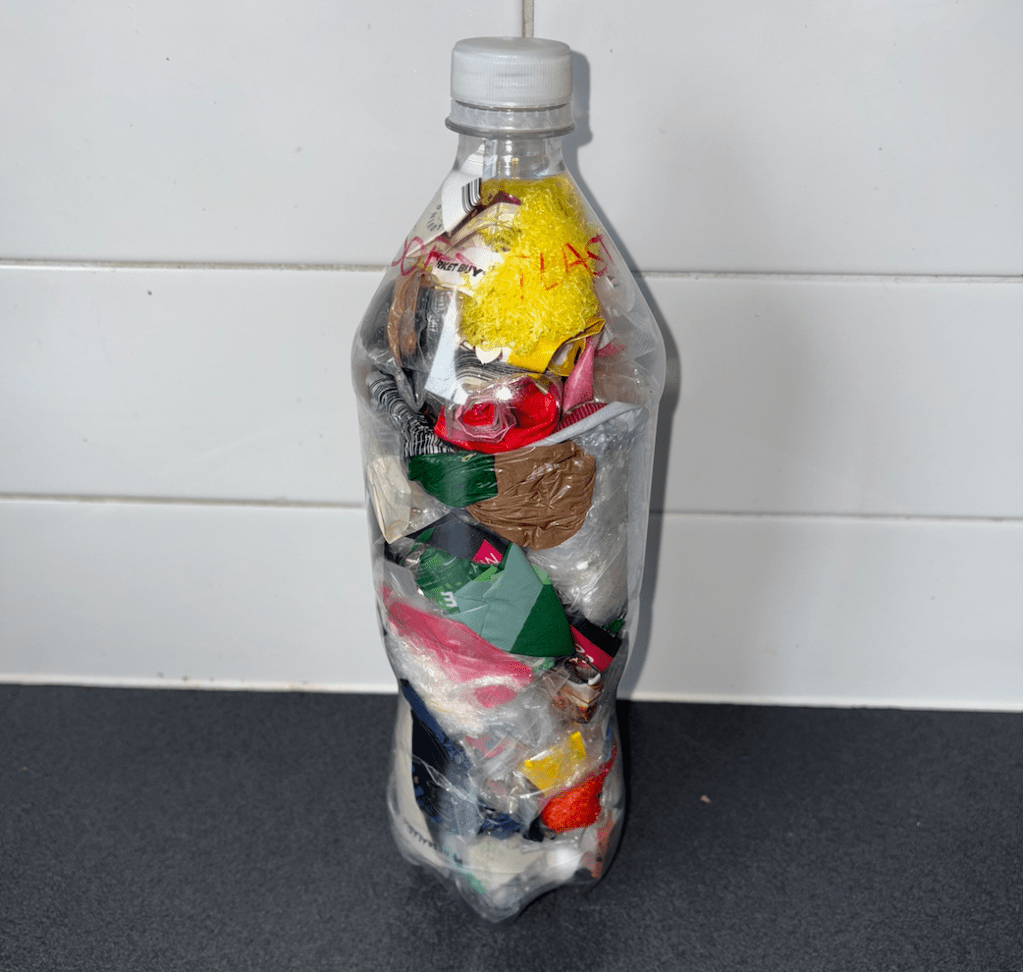
Beside this is the bottle I’ve been using, filled with the plastic I’ve rolled up and shoved inside. You can fit a lot more than you think, so this is probably a couple months worth of items. Unfortunately, it is not everything.
You need to make sure the plastic is clean when it goes inside, so there is no food to rot or release gases. We’ve had to chuck a few pieces that had too much food or which we couldn’t clean properly.
It’s crazy because it makes me also think back to how much plastic I’ve used over the years. If this is a couple months worth, what does twenty-plus years worth of plastic look like?
This is especially important because throwing things into the rubbish bin removes them from our lives, but not from our world. Have you ever stopped to think where your trash ends up?
Like anything in life, plastic waste is also a political and social issue. This article discusses ‘Waste Colonialism‘, and how waste from the Global North (think North America, Europe, UK, Japan, Australia) often ends up in landfills in the Global South.
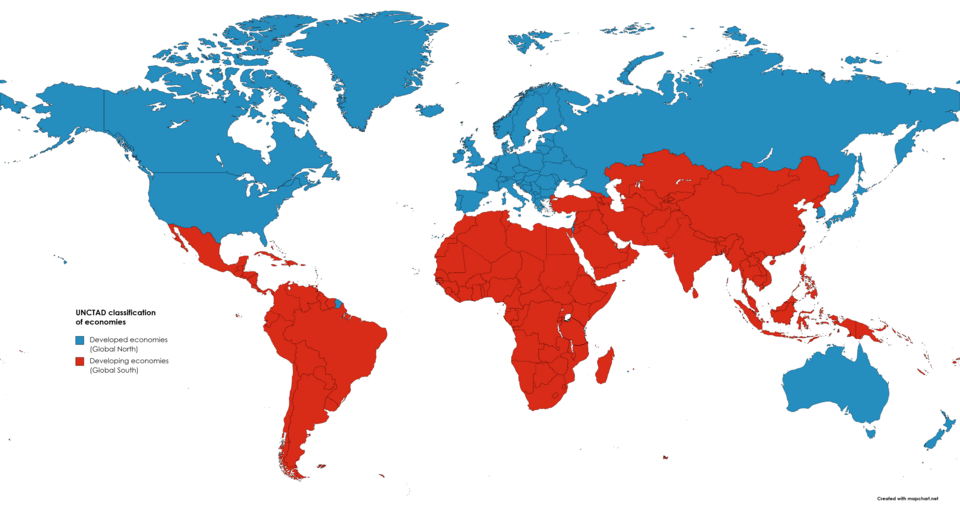
Mutti’s article says waste colonialism “refers to wealthy nations exporting plastic and other types of waste to poorer countries, often under the guise of recycling” (2025). Malaysia, Vietnam and Indonesia are some of the largest sites for waste exports, though they do not have the infrastructure to manage the influx of rubbish. Further, people have to live in these awful conditions, which is genuinely a crime.
There is no single solution to all this, but there are ways we can make it better. We have to stop making so much plastic and turn to renewable and reusable solutions. The Global North countries need to stop dumping their waste elsewhere and invest in waste management systems and solutions. Maybe waste exports need to be banned entirely to force countries to actually find ways to reduce their rubbish.
In the meantime, I will keep sorting my plastic and looking for ways to stop buying so much. Hopefully this gives you a new perspective on your own waste and plastic use. Let me know what solutions you’re already using/trying, as I’m always looking to improve.


Leave a Reply